
What Dental Implants Cost in Florida and How Patients Pay for Them
Dental implants are one of the largest investments most patients make in their long-term health, and the cost question is usually the first one that comes up at a consultation. The good news is that implant treatment is more accessible than most patients expect once you understand what affects the price, what insurance actually covers, and what financing makes possible. At Rubino Periodontics, we work with patients across Bradenton, Sarasota, Lakewood Ranch, and Parrish to find treatment plans that fit both clinical needs and real-world budgets.
Below, we walk through what dental implants typically cost in our area, what factors push the price up or down, what insurance plans tend to cover, and what your monthly payment might look like if you decide to finance. Contact us today to schedule your appointment with a leading periodontist in Manatee and Sarasota County! You can reach us at 941-201-3055 (Lakewood Ranch implant dentists), 941-209-5052 (Bradenton implant dentists), or 813-331-5845 (Parrish implant dentists).

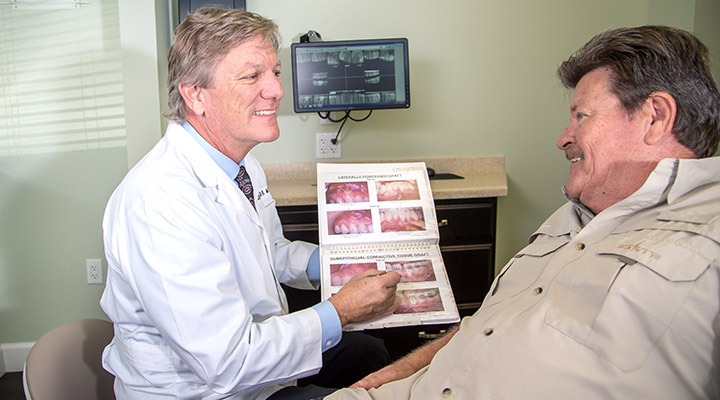
What Determines the Cost of Dental Implants
Two patients walking into our office with what looks like the same problem (a missing tooth, a failing arch, a denture that no longer fits) can end up with very different treatment plans and very different prices. A few of the factors that drive the difference:
- How many teeth you’ll be replacing. A single tooth implant is a fundamentally different procedure from a full-arch restoration. Multi-tooth and full-arch cases involve more implants, more planning, more chair time, and a larger prosthetic.
- Whether extractions are needed first. If the tooth is still in place and has to come out, the extraction is part of the treatment plan.
- Whether bone grafting or a sinus lift is needed. Patients who have worn dentures for years or who have lost teeth long ago often need bone-building procedures to give the implants a stable foundation. These add time and cost but make implants possible for patients who’d been told elsewhere they weren’t candidates.
- Sedation type. Local anesthetic is included in the surgical cost. Oral sedation and IV sedation add to the total, with IV sedation costing more because of the additional staffing and monitoring it requires.
- The implant components and prosthetic material. Premium implant systems (we use Nobel Biocare for many cases) cost more than budget alternatives but have longer track records and better long-term data. Zirconia and titanium-reinforced prosthetics cost more than acrylic but last significantly longer.
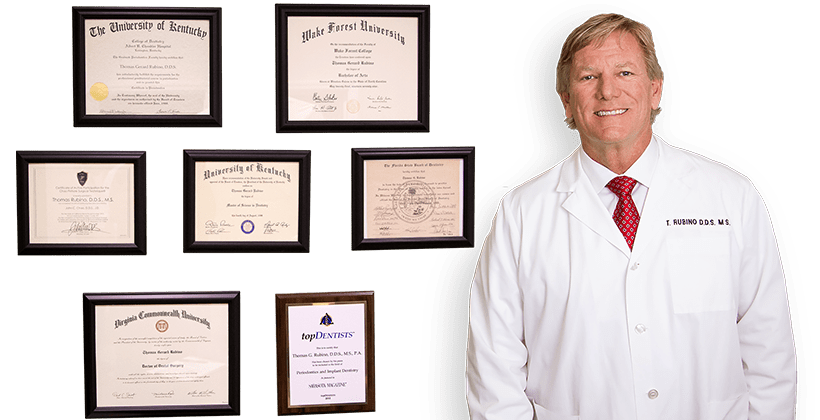
- The surgical provider. Board-certified periodontists generally charge more than general dentists who place implants on the side, because they bring three additional years of surgical training and far higher case volume. The difference shows up most in complex cases and front-tooth aesthetics.
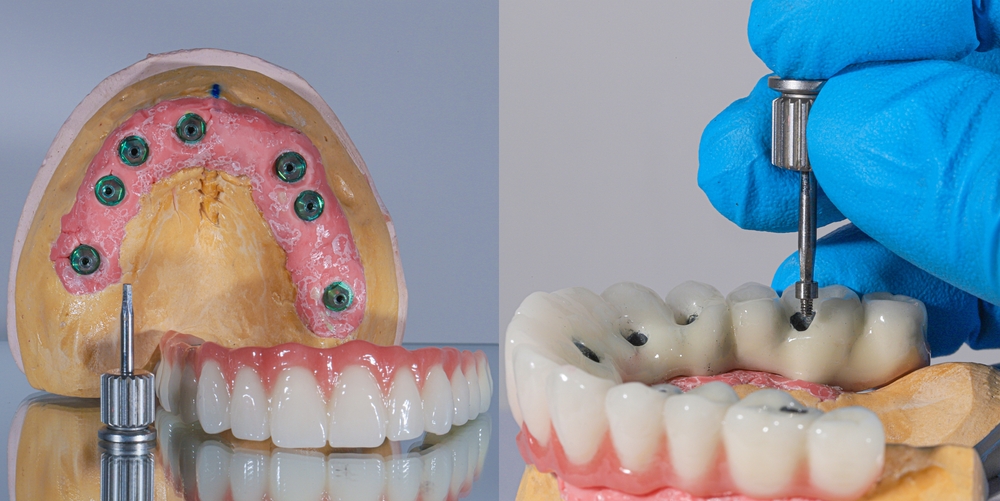
Typical Dental Implant Cost Ranges
These ranges reflect what board-certified periodontists in our area typically charge for high-quality implant treatment. Your specific case may fall above or below.
- Single Tooth Implant: $3,500 to $6,500 for the complete treatment (implant, abutment, custom crown)
- Implant-Supported Bridge (2-4 teeth): $5,000 to $15,000
- Implant-Supported Denture (per arch): $15,000 to $30,000
- All-on-4 Full-Arch Restoration (per arch): $20,000 to $30,000
- Full-Mouth Restoration (both arches): $40,000 to $55,000
Nationally, full-mouth implant procedures often run between $22,000 and $55,000, so our area is consistent with national pricing for specialist-placed implants.
Add-on procedures that may apply:
- Bone Grafting: $500 to $3,000, depending on the size and complexity of the graft
- Sinus Lift: $1,500 to $5,000
- Tooth Extraction: $200 to $700 per tooth, depending on whether the tooth is fully erupted or impacted
- IV Sedation: $500 to $1,500 for the surgical appointment
What Dental Insurance Typically Covers
Insurance coverage for implants has improved significantly over the past decade. A few patterns to know:
- Most plans cover at least part of the surgical phase or extractions when the procedure is deemed medically necessary. The implant itself is sometimes covered as a major restorative service, particularly on PPO plans with stronger benefits.
- Most plans cap annual maximums between $1,500 and $3,000. For larger cases, this means insurance covers a portion of one phase of treatment in one calendar year, and you may benefit from splitting treatment across two benefit years if your timeline allows. Our front office team will look at your specific plan and tell you whether this strategy fits.
- Medicare does not cover routine implant treatment, though some Medicare Advantage plans include limited dental benefits.
- HSAs and FSAs are eligible to be used for implant treatment, which is a meaningful benefit for patients who fund those accounts.
Our front office team will run a benefits check before treatment begins and give you a written breakdown of what your insurance is expected to cover, what your out-of-pocket will be, and how to maximize your benefits. There’s no obligation at the consultation stage.

Financing Options That Make Implants Affordable
For patients whose out-of-pocket falls outside what they can pay upfront, financing turns implant treatment into a manageable monthly payment. We work with several third-party financing partners that offer:
- Monthly payments starting around $300 for many treatment plans
- 0% interest promotional periods for qualifying patients, typically 6 to 24 months
- Longer-term financing (36, 48, or 60 months) with fixed interest rates for larger cases
- No prepayment penalties, so you can pay down the balance faster without extra fees
Common partners patients use include CareCredit, LendingClub Patient Solutions, and Proceed Finance. Each has different qualification criteria and term options. Our front office team will walk you through the choices, help you compare monthly payments side by side, and let you submit applications during your consultation if you want to.
A few patients also use medical credit cards or home equity lines for larger cases, since the rates on those products are sometimes more favorable than dental-specific financing for very large treatment plans. We don’t recommend specific financial products, but we’re happy to talk through what other patients have used.
Why Specialist Pricing Often Saves Money Long Term
Implant cost is sometimes lower at general dentistry offices, particularly chains and discount clinics, and patients reasonably wonder why. The honest answer is that you generally get what you pay for in implant dentistry. A few patterns worth understanding:
- Surgical experience compounds. Board-certified periodontists place implants every day. A general dentist who does occasional implant work has less repetition, which matters most in difficult cases.
- Premium implant systems last longer. Discount providers sometimes use lower-cost implant systems that have shorter clinical track records. When something goes wrong with a budget system years later, replacement parts and components may be hard to source.
- Aesthetic outcomes are harder than they look. Front-tooth implants in particular require precise positioning to look natural. Specialist-placed implants in the aesthetic zone tend to age better.
- Complications are more expensive to fix than to prevent. Failed implants, peri-implantitis, and aesthetic problems that need correction often cost more to resolve than the original treatment would have at a specialist.
That said, cost should be part of the conversation. We’d rather find a treatment plan that fits your budget than have you skip treatment altogether or delay it for years. Many patients combine insurance, financing, and HSA funds to make implant treatment work.
Frequently Asked Questions
Yes. Every consultation includes a written treatment plan with itemized costs, an insurance estimate, and financing options. There’s no charge for the consultation and no obligation to move forward.
We work with third-party financing partners rather than offering in-house payment plans, because the third parties typically offer better terms (longer periods, 0% promotional rates) than we can match in-house. Our team will help you compare options at your consultation.
It depends entirely on the plan. Some PPO plans cover a portion of the surgical phase or extractions, even on full-arch cases, while others classify the procedure as cosmetic and don’t contribute. We’ll check your specific benefits before treatment begins.
Most older adults are good candidates for implants and benefit substantially from the improved nutrition, speech, and quality of life that come with a stable restoration. Age alone isn’t a disqualifier. The question is overall health and bone structure, which we’ll evaluate at your consultation.