Permanent Full-Arch Tooth Replacement at Bradenton’s Original Periodontal Practice
For nearly four decades, Bradenton residents have come to Rubino Periodontics & Implant Dentistry for the kind of implant dentistry that doesn’t exist at every corner office. Our Bradenton dental practice opened its doors in 1988, and the families who first walked in for periodontal care are now bringing in their adult children and grandchildren for implant treatment. If you’re missing most or all of your teeth and you’re ready for a permanent, fixed solution, All-on-4 dental implants can give you back the ability to eat, speak, and smile without thinking twice.
All-on-4 uses four titanium implants per arch to anchor a full set of replacement teeth that stays in place permanently. There’s no slipping, no adhesives, and no daily removal. Dr. Thomas Rubino founded the Bradenton practice and has placed thousands of implants in the years since, with his sons, Dr. Ryan and Dr. Tyler Rubino, now practicing alongside him as second-generation board-certified periodontists.
Call 941-209-5052 today to schedule your complimentary consultation and 3D CT scan at our Bradenton office. We welcome patients from Bradenton, Palmetto, Ellenton, Anna Maria Island, and across Manatee County.
Find out if you may be eligible
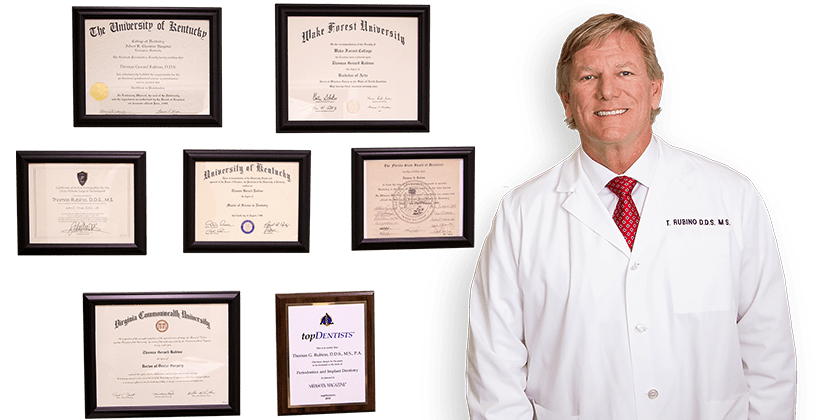
Why Rubino Periodontics & Implant Dentistry Is Bradenton’s Nobel Biocare All-on-4 Center of Excellence
Not every practice that places All-on-4 holds a Nobel Biocare Center of Excellence designation. Rubino Periodontics is one of a small number of practices nationwide to earn that credential, awarded based on case volume, clinical outcomes, and adherence to the Nobel Biocare treatment protocol. For patients in Bradenton considering All-on-4, it’s a meaningful distinction.
The designation isn’t self-reported. It’s based on tracked case volume and outcome data submitted to Nobel Biocare, which means our team has demonstrated proficiency with the protocol at a level that qualifies for formal recognition. Most general dental offices that offer All-on-4 do not hold this credential. Most oral surgery practices do not either. It is held by a select group of periodontists and oral surgeons whose implant volume and outcomes meet Nobel Biocare’s published threshold.
If you’re comparing providers for All-on-4 in the Bradenton area, it’s worth asking whether the practice placing your implants has earned that designation or is simply using the All-on-4 name.
What Are All-on-4 Dental Implants?
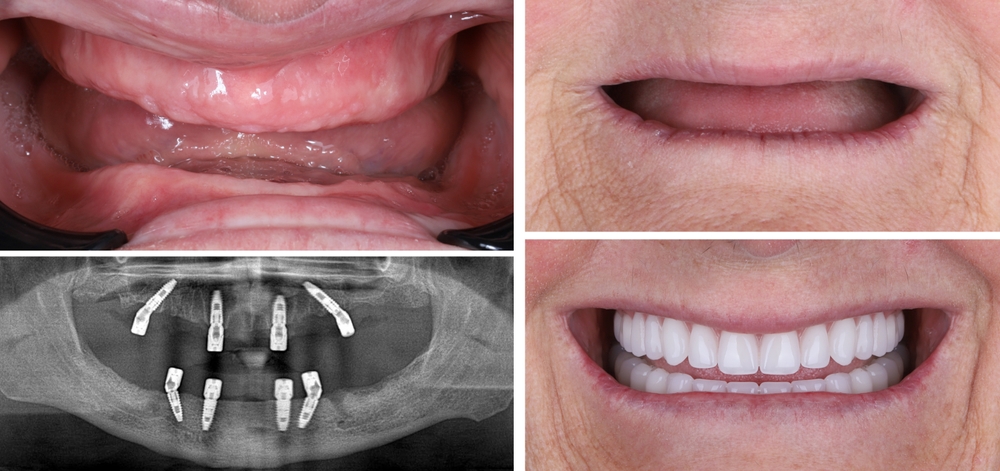
All-on-4 is a full-arch tooth replacement protocol that uses four strategically positioned titanium implants to support a fixed bridge of replacement teeth. Two implants go vertically at the front of the jaw where bone is densest, and two are angled at the back to make use of available bone without requiring sinus lifts or extensive grafting.
The result is a complete set of teeth (upper, lower, or both) that stays permanently in place. Unlike traditional dentures, All-on-4 doesn’t rest on the gums, doesn’t require adhesives, and doesn’t move when you talk or eat. Patients regain close to full chewing power and can return to foods they’ve avoided for years.
The protocol was developed by Dr. Paulo Maló and refined in partnership with Nobel Biocare. It now has decades of clinical data behind it, with long-term success rates above 95% when placed by experienced periodontists.
The All-on-4 Procedure at Our Bradenton Office
The full All-on-4 process generally takes four to six months from consultation to final restoration. Most patients leave their surgical appointment with temporary teeth already in place.
Consultation and 3D Planning
Your first visit includes a clinical exam, a 3D cone beam CT scan, and a detailed conversation about your goals, medical history, and expectations. We use digital planning software to position the implants down to the millimeter before you’re in the surgical chair.
Surgery and Same-Day Temporaries
On surgery day, any failing teeth are extracted, four implants are placed per arch under local anesthetic or IV sedation, and a temporary bridge is attached the same day. You leave with a functional set of teeth and clear instructions for the soft-food phase of healing.
Osseointegration
Over the next three to six months, the implants fuse with your jawbone (osseointegration). You wear your temporary bridge during this time and come in for check-ins so we can monitor healing.
Final Restoration
Once integration is complete, your temporary bridge is replaced with a custom-designed final restoration in zirconia or a titanium-reinforced hybrid material, both built for long-term durability and a natural appearance.
Sedation and Comfort
Our Bradenton office offers local anesthetic, oral sedation, and IV sedation. Many patients choose IV sedation for the surgical day and have no memory of the procedure itself.
Are You a Candidate for All-on-4?
Most patients missing all or most of their teeth in one or both arches are candidates for All-on-4. The protocol was developed specifically for patients with significant tooth loss, including long-term denture wearers and patients whose remaining teeth are failing.
Good candidates typically include:
- Patients missing all teeth in one or both arches
- Long-term denture wearers experiencing slipping, sore spots, or difficulty eating
- Patients with failing teeth from advanced periodontal disease, multiple fractures, or extensive decay
- Patients with moderate bone loss who have been told they need extensive grafting (the angled posterior implants in All-on-4 often eliminate this need)
- Adults in reasonably good general health
Conditions that may delay or complicate treatment include uncontrolled diabetes, heavy active smoking, untreated periodontal disease, and severe bone loss in the front of the jaw. At your Bradenton consultation, our team will review your medical history, evaluate your bone with 3D imaging, and let you know whether All-on-4 is right for you or whether a different option makes more sense.
How Much Does All-on-4 Cost in Bradenton?
The cost of All-on-4 varies based on your specific case, but Manatee County patients should generally plan for $20,000 to $30,000 per arch when treatment is provided by a board-certified periodontist with high-quality materials. Both arches typically fall between $40,000 and $55,000.
Factors that affect cost include:
- Extractions needed before placement
- Whether any bone grafting is required (often avoided with All-on-4)
- Sedation type
- Final prosthetic material
- Imaging and surgical planning
Most insurance plans cover part of the surgical phase and any extractions, though full-arch restorations are usually not fully covered. Our Bradenton front office team will review your benefits with you in detail. We also offer financing through third-party partners with monthly payments starting around $300, which brings treatment within reach for many patients who initially thought it was out of budget.

Benefits of the All-on-4 Process
Bradenton All-on-4 patients tend to tell us the same thing: they wish they’d done it sooner. The benefits show up quickly and add up for years.
- The foods that have been off the menu come back. Stone crab at Star Fish Company in Cortez, smoked mullet at the Bradenton Beach Pier, a real steak at Pier 22, and fresh grouper sandwiches from Anna Maria Island. Many patients bring photos from their first big meal after the final restoration.
- Speech returns to normal. Loose dentures click and slip, which is exhausting if you’re a regular at LECOM Park for Pirates spring training or at the Bradenton Riverwalk farmers market. With All-on-4, conversation feels natural again.
- Confidence comes back. Smiling in photos at the Village of the Arts ArtWalk, laughing at dinner without thinking about your teeth. For patients hiding their smile for years, the difference is hard to overstate.
- The treatment is a one-time decision. No more relines, no more new dentures every few years, no more adhesives. With good care, the implants last a lifetime, and the prosthetic typically lasts 10 to 20 years.
Caring for All-on-4 Dental Implants
Maintaining All-on-4 is similar to caring for natural teeth, with a few adjustments for the fixed bridge design:
- Brush twice daily with a soft-bristled or electric toothbrush, paying attention to the gumline
- Use a water flosser nightly to clean under the bridge where regular floss can’t reach
- Schedule six-month visits at our Bradenton periodontal office for cleaning, fit checks, and X-ray monitoring of bone levels around the posts
- Adjust your chewing pattern if you converted from a traditional denture, since the fixed bridge doesn’t need to be repositioned mid-meal
- Avoid using your teeth as tools, no chewing ice, opening packages, or cracking hard candy
- Ask about a nightguard if you grind at night to protect the prosthetic from wear
With consistent home care and regular six-month visits, most All-on-4 patients enjoy the same restoration for 15 to 20 years before the prosthetic needs replacement. The implants themselves typically last a lifetime.
Frequently Asked Questions
Most All-on-4 surgeries run two to four hours per arch, depending on whether extractions are needed. Patients receiving both arches on the same day should plan for a half-day at our Bradenton office. Sedation makes the time pass quickly, and most patients are surprised by how short the recovery feels once they’re home.
In most cases, yes. Dr. Thomas Rubino founded the Bradenton practice and continues to see patients. Dr. Ryan and Dr. Tyler Rubino practice alongside him. For All-on-4 cases, the team typically reviews your treatment plan together, so you have multiple board-certified periodontists weighing in on your care.
In most cases, yes. Long-term denture wear does cause progressive bone loss, but the angled posterior implants in All-on-4 are designed to work with reduced bone in many patients. A 3D CT scan at our Bradenton office will give us a clear picture of your bone structure and tell us what’s possible.
Traditional implant treatment typically replaces each missing tooth with its own implant or uses several implants to support a bridge. All-on-4 replaces an entire arch using only four implants, which keeps the procedure shorter, less expensive, and possible for many patients who don’t have enough bone for traditional implant approaches.
BOOK AN APPOINTMENT